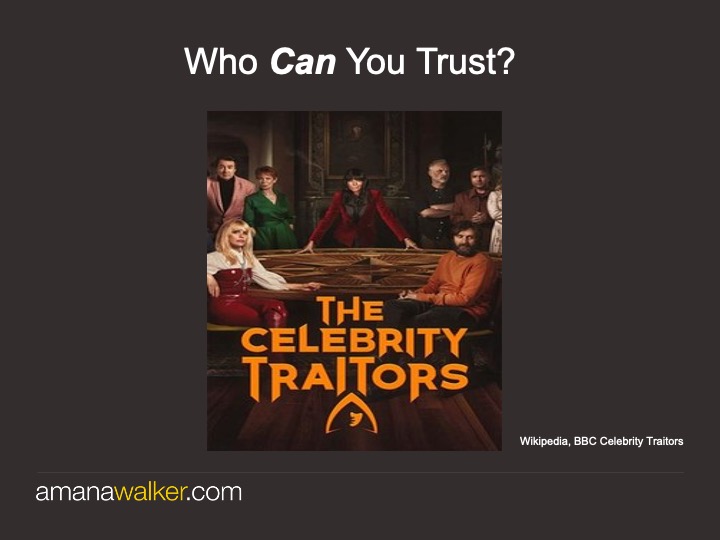
BBC’s The Celebrity Traitors isn’t just a game show – it’s a gripping psychological experiment with the added drama of medieval cloaks and castle intrigue.
Behind the missions, banishments, and corridor whispers are lessons to be had for all of us in what it means to trust, deceive, and figure out the truth in a world (often) built on lies. Watching the contestants navigate their way through suspicion and manipulation has us laughing out loud, keeps us gripped and gives us more than entertainment.
It really is a mirror reflecting how we judge, doubt, and decide. In real life.
Who Can You Believe?
In The Celebrity Traitors, as in real life, it’s all about belief. Every word, glance, and gesture is weighed up. Is it real? Is it exaggerated for effect? The celebrities have to decide who to trust, knowing full well that betrayal and deceit is all part and parcel of the game.
Of course, in everyday life, we like to think we’re better equipped, and we can’t be fooled – but we’re not and we often are. We tend to believe people who mirror our own attitudes, appear confident, or fit our mental image of what we consider to be ‘trustworthy’. We base our judgments on appearances and voice tone rather than looking closely at more consistent evidence. The show exposes just how fragile and dangerous that process can be: a convincing smile (hello Alan Carr) can hide deceit, and quiet but honest people can be the first to fall under suspicion.
So How Do You Know If Someone Is Being ‘Faithful’?
Faithfulness, like honesty, in friendship, relationships, or with colleagues at work – is built on reliability over time. But in the TV programme, the Celebritiestime don’t have that time; gaining trust has to be done fast. Players in the game have to rely on instinct, or pattern spotting, and that all-important emotional connection to decide if someone is a Faithful, or in fact, a Traitor.
In real life, signs of faithfulness are subtle: openness, genuine words and actions that prove it. But the show reminds us that even those things can be faked. So, what’s the lesson? It’s about knowing that faithfulness isn’t about someone never deceiving you, it’s about someone deliberately and consistently choosing to. Look closely, are you often let-down by someone, or catch them out by chance or are you understanding of them you knowing that they rarely disappoint you?
The Power of a Loud or Convincing Voice
Why do we so often believe the person who speaks the loudest, the longest, or the most confidently? Social psychology offers an answer: confidence is believable – and contagious. In uncertain situations like the paranoia – fuelled halls of The Celebrity Traitors’ castle, people look for cues of certainty. A forceful personality (Jonathan Ross anyone?) can shape group decisions simply by appearing more sure.
We mistake conviction for correctness. The louder voice doesn’t necessarily hold more truth, it just has more presence. Watch The Celebrity Traitors and you’ll see how easily the other players fall in line behind a persuasive leader, even when their intuition is screaming something different. The show tells us a truth about us humans: we want direction, even if it does lead us astray.
Looking For Clues: Reading Micro Movements and Inconsistent Behaviour
A flicker of the eyes. A swallowed breath. A too – eager denial. As in real life, The Celebrity Traitors thrives on these tiny, tell-tale cracks in performance. The contestants and (let’s be honest) us viewers, become amateur detectives, searching for ‘micro expressions’ – the fleeting signals that reveal emotion before it can be concealed.
But body language is context dependent. Someone crossing their arms might just be cold, and not being negative or defensive. But when behaviour is inconsistent with a person’s words – that’s when it’s worth noticing.
In life, as in the game, the most reliable clue isn’t always a twitch or a smirk, it’s behaviour that doesn’t fit the story being told.
Having the Courage of Your Own Convictions
The hardest part of The Celebrity Traitors (for me at least) is watching someone know the truth, say it out loud, and still be drowned out by the crowd. Having the courage of your convictions and sticking to them even when others disagree is critical.
Whether you’re in a castle or at work, courage often looks like quiet persistence. It’s trusting your own gut or using real evidence and not letting fear of being wrong silence your voice. The contestants who thrive are those who can listen, doubt wisely, and act decisively – not those just listen to the loudest people in the room.
In the End: It’s A Game That Isn’t Just a Game
The Celebrity Traitors distils is all about trust vs. deception, confidence vs. truth, and going with the crowd vs. being courageous enough to stand alone. It’s thrilling because we can recognise ourselves ; our biases, our frustrations , even our tendency to follow the confident and question (or ignore) the quiet.
The real takeaway? Only we can decide who earns our trust. Only we can be alert to inconsistent behaviour – what to pay attention to and what to ignore and only we can build up the courage to speak up and act on what we know we see.
Now, could you guess the ‘Traitor’ in the TV programme – and do you reckon you could spot a traitor in real life?
amana
Spotlight Coach
Straightforward, straight talking